

IMPOSSIBLE IMAGINAR RES
Atresbandes
15 €
24 - 26 September 2026
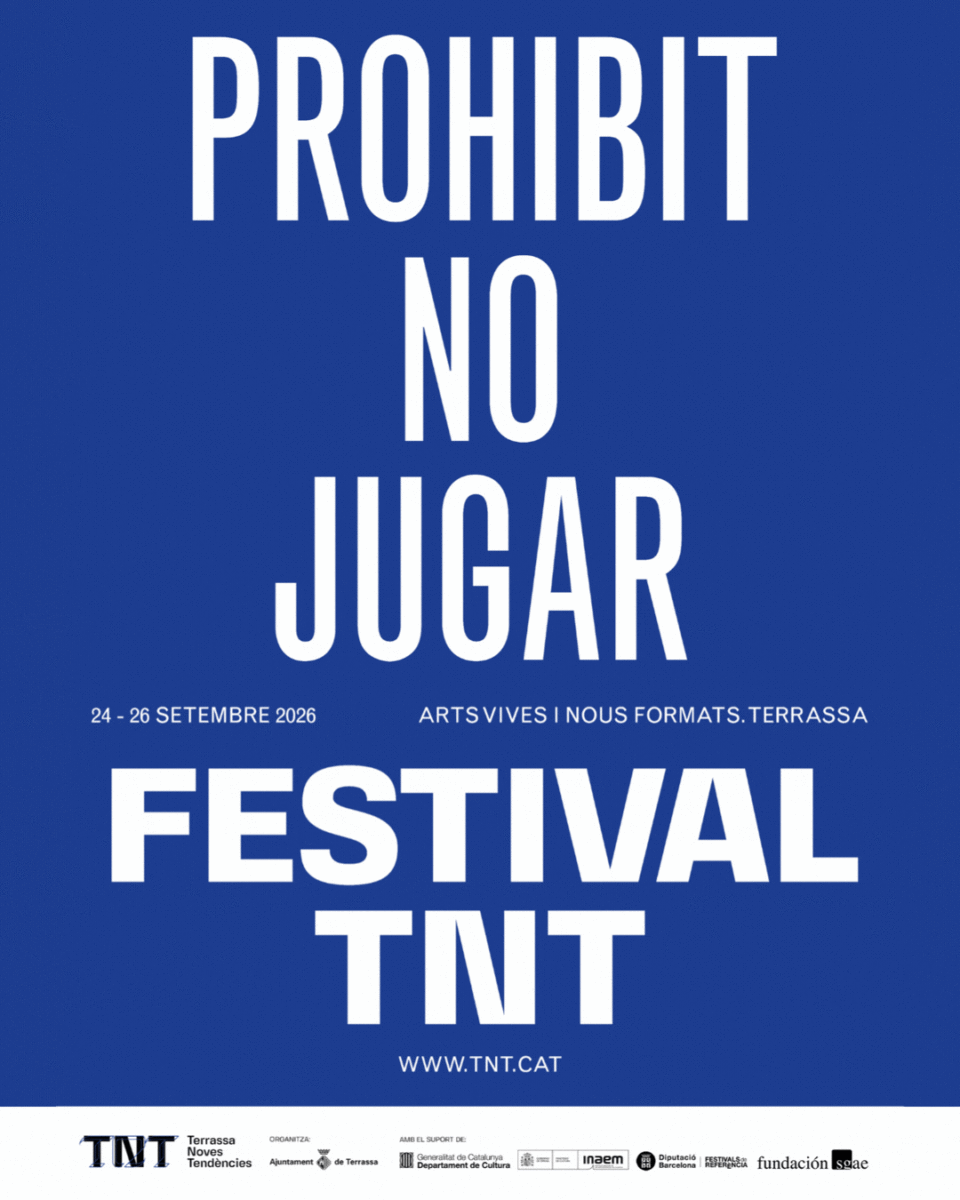
Forbidden not to play. That is one of the phrases emblazoned across this year’s poster. A provocation, a moment of disorientation, a small jolt. A play on words designed to combat the apathy of the present moment. A prohibition that ultimately becomes an invitation. It is also a kind of profanation: what would normally impose limits here opens up a possibility. At the risk of sounding naïve, play is one of the most serious ways of imagining other worlds. Like the famous Situationist slogans— “Never work” or “Beneath the paving stones, the beach”—, this year’s poster seeks to interrupt the ordinary, hold our attention for a moment and compel us to read again.
One of the festival’s ambitions this year is to make itself visible throughout the city. That is the thinking behind TNT a les places (TNT in the squares): an invitation to leave the house and head outdoors to play, dance, breathe or simply let yourself be carried along. Six performances, spanning a wide range of formats and artistic languages, will take over squares and public spaces in a celebration of collective experience. La Chachi returns to Terrassa to shake up its streets with one of her most acclaimed works, Taranto Aleatorio, which returns flamenco to everyday life: irreverent, unpredictable and rooted in the ordinary. Kms of Resistance by Moroccan artist Mehdi Dahkan is an intense choreographic exercise in which breathing ceases to be an intimate gesture and becomes a shared experience. María Garcia Vera presents a deeply personal solo, crafted with humour, intelligence and unlikely connections, in search of a path that might keep us from losing our way as we gaze at the sky above us: La Vía Láctea. We can also see La luz del lobo no pesa by Pere Jou and Aurora Bauzà, a musical and light installation that transforms Vallparadís Park by inviting us to inhabit it differently (one performance will also feature the participation of the Montserrat Choir of Terrassa). Completing the public programme are two productions for audiences of all ages, to be presented at different locations across the city: Checho Tamayo, a former footballer, brings Oxímoron, a participatory piece that blurs the boundaries between art and sport, transforming emotion and difference into a shared language, while Granotes al cel, aigua a la terra by Banda Esfèrica harnesses the power of bodies to face life with optimism and, along the way, call down the rain.
As always, the festival will also take over Terrassa’s theatres and more unconventional venues. Teatre Alegria will host three productions that, through very different artistic languages, confront the contradictions of the present. María Jurado premieres Angelical, a creation that questions the figure of the angel, so deeply embedded in the contemporary imagination as a repository of values associated with goodness, purity and perfection. Atresbandes presents Impossible imaginar res, a piece that moves between imagination and reality to ask whether it is still possible to imagine the future without succumbing to pessimism. Meanwhile, Clap & Slap by Agniete Lisičkinaite and Igor Shugaleev, brings together on stage two artists from Lithuania and Belarus, countries that stand on opposite sides of the war that continues to devastate Ukraine. That dialogue, almost unimaginable in the political sphere, finds in theatre the possibility of existing. All three productions hybridise body, image and thought, transforming the stage into a space for shared reflection,
The festival’s most radically personal works come from Rosa Romero, Manuel Rodríguez and Inka Romaní: three artists of extraordinary power presenting three solo performances born from the deepest personal experience —shaped by autobiography and emotion— and understanding dance as a dialogue with everything that makes us who we are. Rosa Romero presents El discurso, a piece that, from a feminist perspective, delves into inarticulate sound, moans, cries and babbling as ways of overflowing the hegemony of words and logic. Manuel Rodríguez presents Zero, a creation shaped by the death of his mother, over which hover both mystery and the search for a voice of his own, visceral and beyond verbal language, as well as for a movement that oscillates between fragility and strength. In Volvemos al baile, Inka Romaní recovers a dance that survived the Franco dictatorship hidden within the bodies of grandmothers. These three works, like Mehdi Dahkan’s, share the intuition that there exists a language capable of saying far more than words ever can.
We continue with three productions that explore different politics of visibility and the ways in which we inhabit the world. (cau), by Quim Bigas, approaches these questions with humour and sharp insight, asking what happens when we want to hide but cannot. How do we respond to conflict? Where do we seek refuge in times of crisis? These are questions addressed to audiences of all ages, with particular attention to younger people. Elena Carvajal also reflects on visibility, drawing on cinema to shift the focus onto the extras and, by extension, those who remain on the margins, in the shadows, outside the frame. What is it that makes us visible? And in one of the most distinctive venues of this year’s festival—a nineteenth-century industrial building that once housed a rubber factory, we will experience Everafter, by laSADCUM, a show that delves into the digital universe and the capitalist exploitation of fantasies of self-improvement, where the need to make oneself visible also becomes a form of control.
In collaboration with El Corralito CCA, a local space dedicated to emerging creation, the festival will host open work-in-progress presentations by suPreema and her Petit-Suis in which the artist develops a distinctive artistic language to investigate the archetype of the “demonic girl” in contrast to the “good girl” so prevalent on social media. Adrià Sánchez Campo turns to objects, autofiction and humour to explore the territory of childhood and evoke the absences that shape us.
And because this festival is also about play in its most literal sense, younger audiences will find in El laberinto no se mueve by Macarena Recuerda, a sensory installation designed for getting lost, exploring and surrendering to the experience through light, music and touch.
If only we did not forget so quickly that play is a way of resisting boredom, inertia and the unbearable fixedness of things. An attempt to shift our perceptions, alter logic and connect with one another. A possibility to remake, or simply to rehearse. As Mary Oliver wrote: Every morning/ the world/ is created. And I think that, perhaps, this festival is about that too
Hosted by:

Collaborators:
Media partners: